AI Agents
an Agent is defined as a fundamental entity,
- who perceives its environment
- then makes decisions
- then take actions
- to achieve a specific target
perceive become aware of something / come to realize
Core feedback loop
all agents Act on a feedback loop.
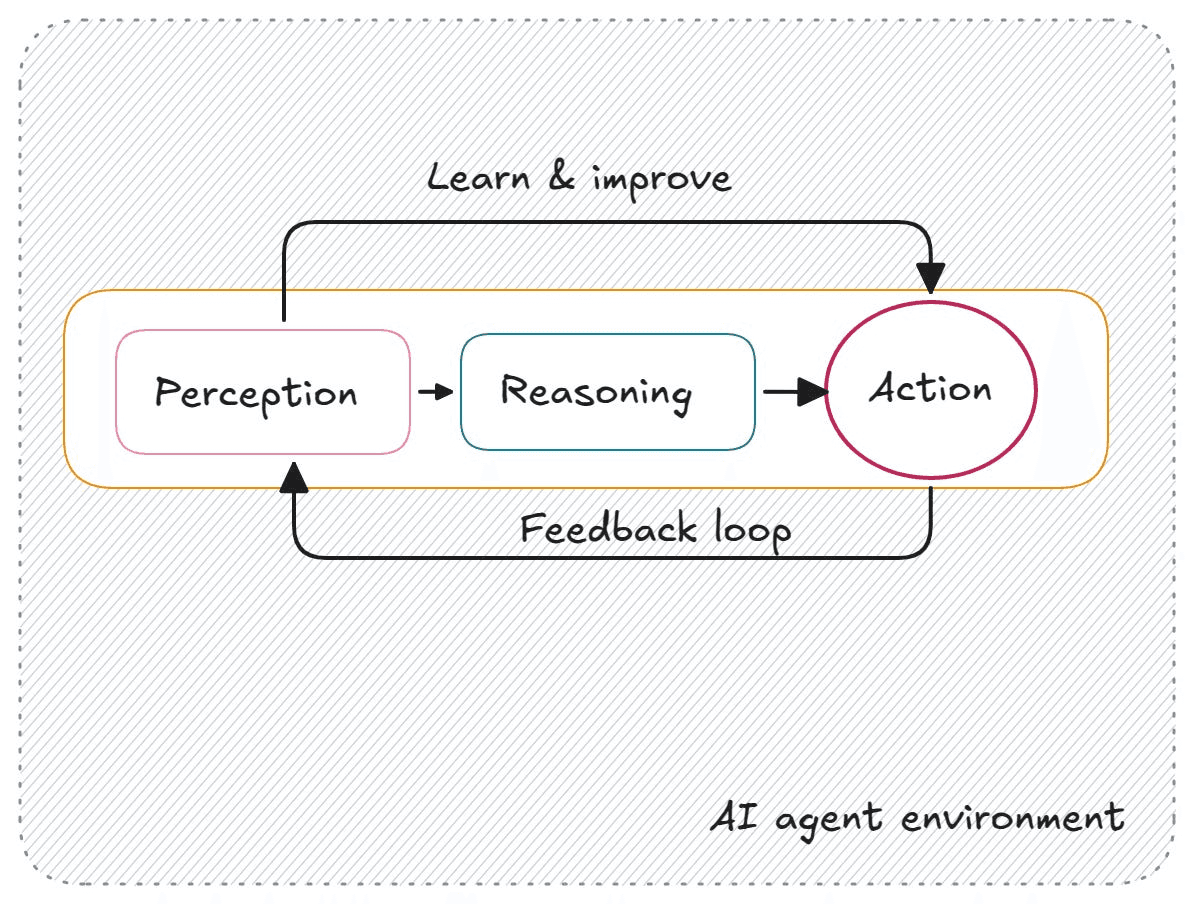
- Sensors (perception) - this is how the agent see the environment
- eg: Camera feed, gyroscopes, motion sensors, text inputs, database updates
- Decision Maker (brain) - this is the logical part. This evaluate the current state & determine what to do next
- eg: logical program, Machine Learning model
- Actuators (actions) - this is how the agent change its environment.
- eg: Clicking a button, increasing a motor speed, output text
An Agent or Not?
| This is not an Agent | This is an Agent | |
|---|---|---|
| Description | A basic thermometer that displays | An AC that maintain room temperature at |
| Reason | This perceive environment, but no Action or pursue a goal. | This perceive environment ,take decision the temperature should be lower,Then reduce the temperature,Keep at (goal) |
Terminology
Percept Sequence
A full history of everything the agent has perceived
Agent Function
A mathematical function that maps the percept sequence into an action
Agent Program
Implementation of the Agent function using code. Can be considered the brain of the agent. More Details - Agent Program
Agent architecture
The computing device with physical sensors and actuators on which the agent program runs.
Rationality
Choosing the "Action" to maximize performance based on percept sequence and built-in knowledge. The action is based on known and perceivable knowledge, thus called rational.
ex: Looking both ways before crossing a street is rational. If a meteorite hits you mid-crossing, the outcome is disastrous, but the decision was still rational because you acted correctly based on what you could observe and predict.
Omniscience
An agent is omniscience if it knows everything about the outcome that happen for all taken actions beforehand. Rational Agents and omniscience agents are completely different. In real world, an agent cannot be omniscience due to,
- Inherent uncertainty in complex environments
- Computational limitations
- Incomplete information
Performance Measures
The agents' performance is measured using some predefined metrics. These measure how successful an agent is by asserting the environment. Key important thing is defining these correctly is essential for the agent to achieve the goal.
- Poor Design (Measuring Means): Awarding a vacuum-cleaner agent points every time it picks up dirt. Result: The agent intentionally dumps dirt on the floor and picks it back up repeatedly to farm points. (Known as Reward Hacking)
- Good Design (Measuring Ends): Awarding points for having a clean floor over a sustained period. Result: The agent cleans efficiently and keeps the space clean.
Outcomes should be evaluated, not the Actions