Fundamentals of Thermodynamics
This is a study in physics about heat, work, temperature, and energy transformations across systems.
Different forms of Energy
Energy stored in a system can be microscopic and macroscopic.
- Microscopic energy:
This is the energy in the system in the internal reference frame (relative to the system itself).
i.e. When we think about the internal structure of the system. Energy stored within the atoms' molecular motion and atom bonds of a system.
- Chemical, Nuclear Energy, Sensible Energy
- Macroscopic energy:
This is energy in the system from the external reference frame (relative to the outside world). i.e. When we think about the system as a whole from outside.
- Kinetic & Potential Energy
Ways energy transforms
in Thermodynamics, energy transfers using one of two ways only.
- Heat () Energy transfer from a system boundary solely by change of temperature
- Work () Energy transfer from a system boundary by a force acting at a distance. All sorts of energy transfers occur this way. (eg. Kinetic -> Potential, Electricity -> Kinetic)
Types of systems
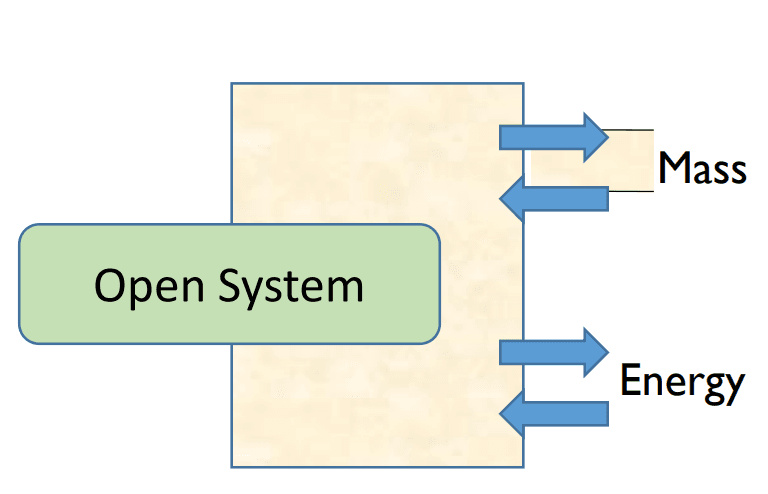
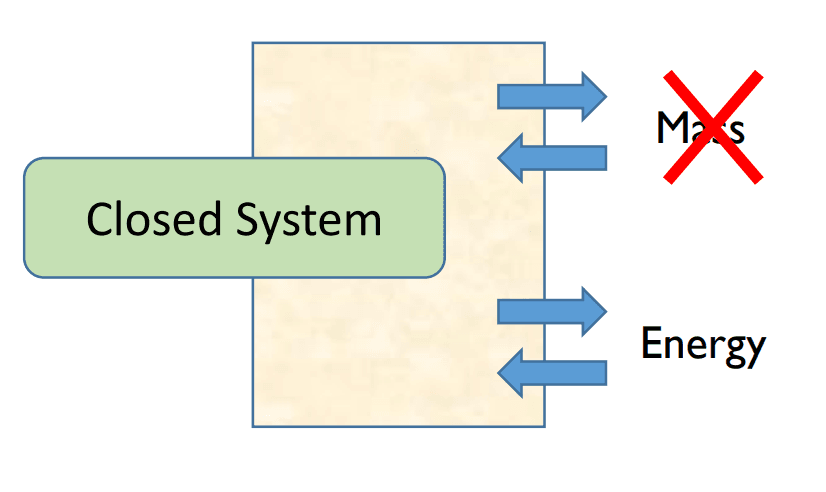
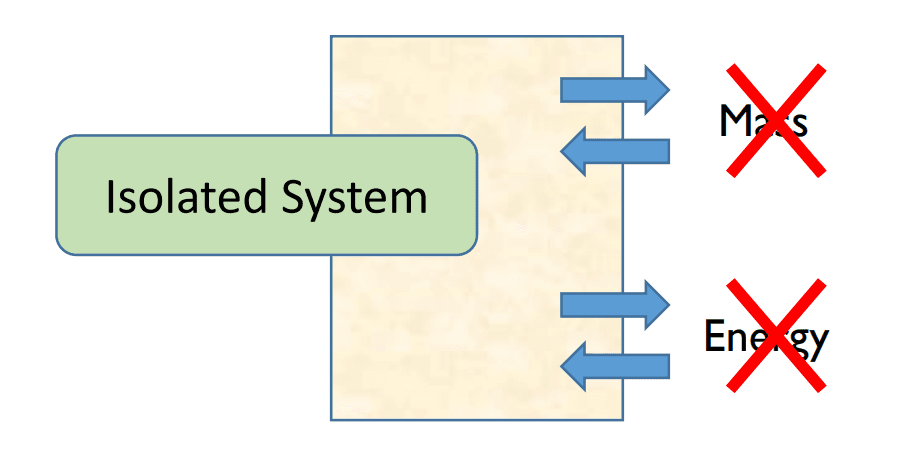
We define a system boundary in thermodynamics by what can be transferred in and out.
-
Open System (Control Volume)
-
Closed System (Control Mass)
-
Isolated System
Thermodynamic Properties
Divided into three categories
-
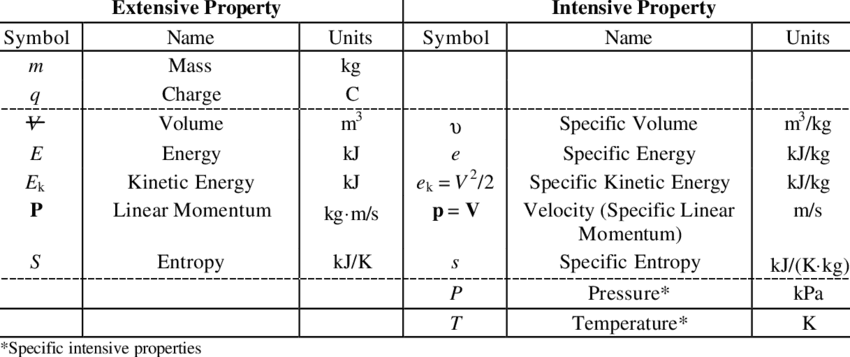
Intensive These properties are independent from mass or size. (Does not change value for different masses) eg. Temperature, Pressure, Density
-
Extensive These properties do depend on mass or size. eg. Total mass, Total internal energy, Total Volume
-
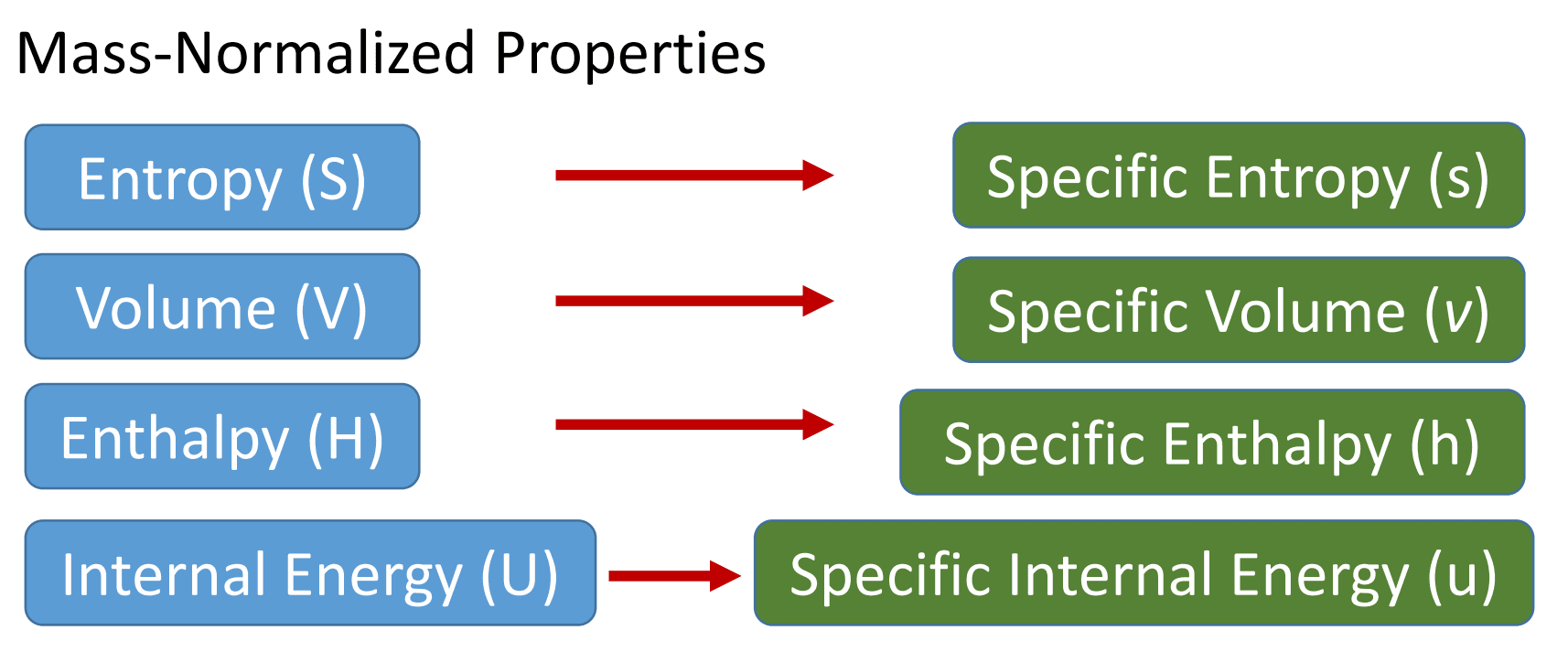
Specific These are extensive properties which are Mass Normalized. These are divided by mass and made intensive.
More details
Properties are known as Point functions. This is because they only depend on the point, not the path it followed to each state.
Thermodynamic States
A State is a single instance of a system that is defined by thermodynamic properties. These properties act as state variables.
State Postulate
This tells How many independent state properties are required to fully define the system state.
The thermodynamic state of a simple compressible system is completely specified by two independent, intensive properties.
This comes from ways you can transfer energy in a simple compressible system. For any system,
- Heat Exchange is possible for any thermodynamical system (the first one)
- Rest is how many different ways we can do work on that system.
- Can you magnetize it? (No, ignored in simple compressible systems)
- Can you stretch it like a wire? (No)
- Can you run an electric field through it? (No)
- Can you change its surface area like a bubble? (No) In a simple compressible system, the only way to do work is changing the pressure against volume.
Because of this, we can define a state using only two properties for this case. This is far more easy than like defining the position, velocity of each atoms for example.
State Functions vs Path Functions
State Functions (Properties)
These are point functions on a property diagram (- or -). The change in a property depends only on the initial and final states:
These do not change by the path that took when the change of property occurred. Mathematically, state functions form exact differentials (). Exact Differential Equations
Path Functions
Values depend entirely on the specific path or process taken between two states. Heat transfer () and work transfer () are not properties.
Mathematically, they form inexact differentials (), meaning there is no such thing as "heat at state 1" () or "change in work" (). Further explaining, heat does not defined for a state, it is defined for a path.
Thermodynamic Equilibrium
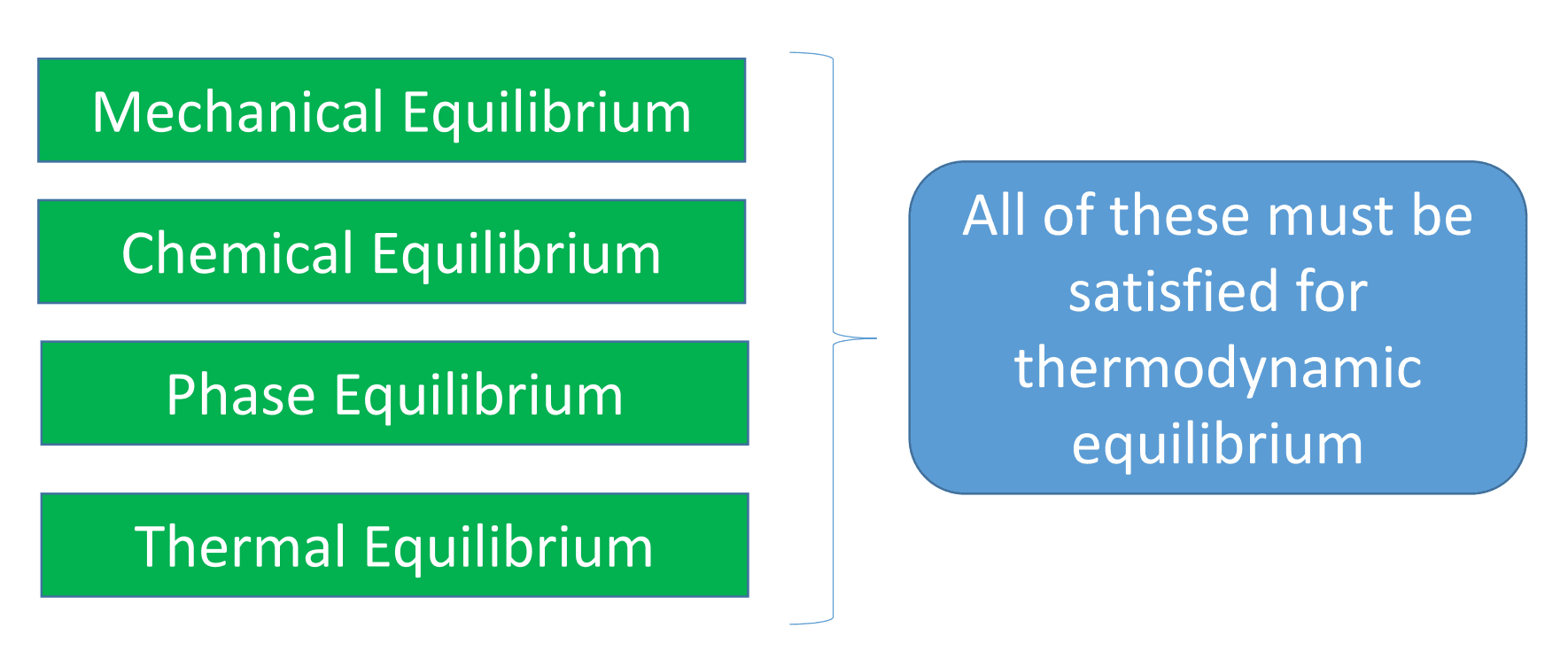
This is a state of a system that experience no change whatsoever.
By Change, it means no property changes over time. Nothing flows through it.
Thermodynamic Equilibrium vs. Steady State
It is easy to confuse equilibrium with a steady-state condition, but they are fundamentally different:
- Thermodynamic Equilibrium: No property changes over time, and no net flows of energy or mass enter or leave the system ().
- Steady State: Properties inside the system remain constant over time, but energy or mass actively flows through the system at a constant rate (e.g., water flowing through a steady-state heater at a constant ).
Thermodynamic Processes
A process is a continuous change that transition a system from one Equilibrium state into another one.
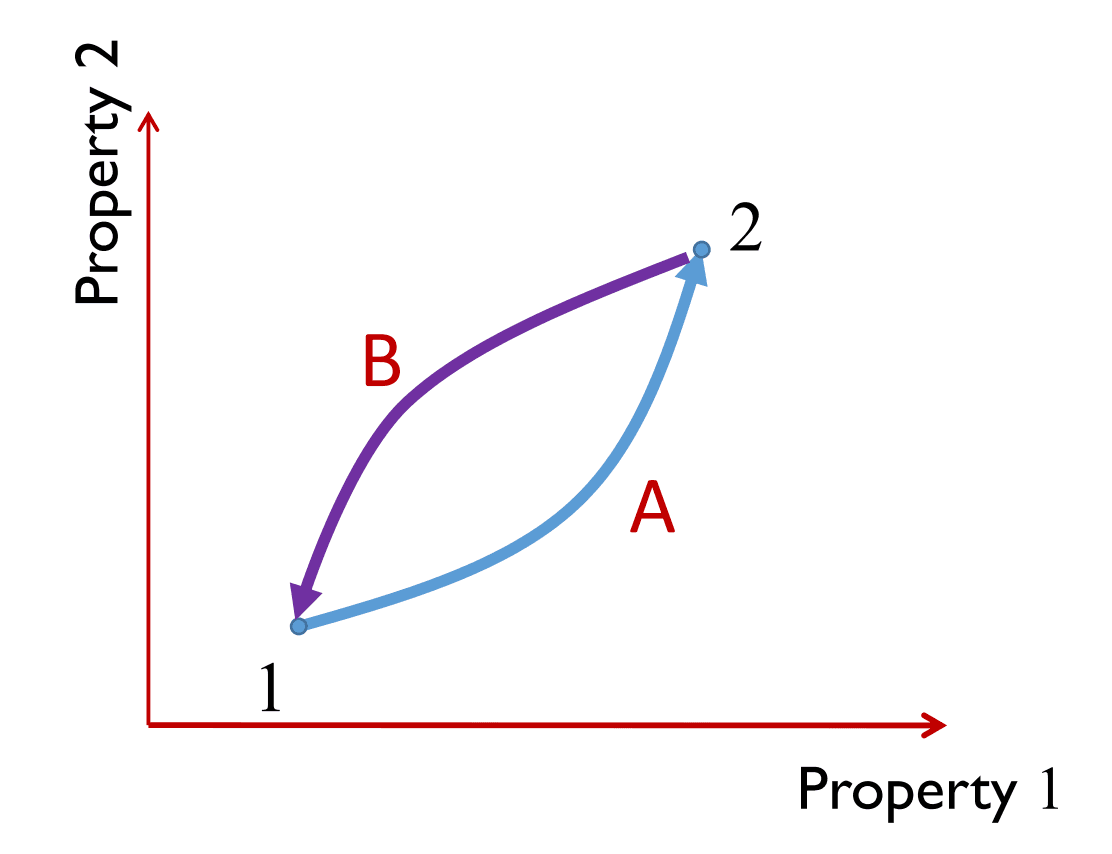
- are States
- are processes
Different types of Processes
-
Isobaric (Fixed Pressure) Iso-baric - Pressure
-
Isochoric (Fixed Volume) Iso-choric - Space
-
Isothermal (Fixed Temperature) Iso-thermal
-
Adiabatic (Absolutely NO Heat Transfer) adiabatos - Impassible
-
Isentropic (Fixed Entropy) Iso-Entropic
-
Polytropic ( is constant) Poly-tropic (Many-Changing), but the Product is constant.
Quasi means "Almost"
This is an idealized process that proceeds so infinitely slowly that the system remains infinitesimally close to thermodynamic equilibrium at every single moment.
Basically, if you change something so much slowly, it wouldn't be noticed.
Reversible vs Irreversible Processes
Reversible process is a process that can be reversed in such a way so the entire universe will be as same as it was at the initial state of the process when the reverse is done. This is only an idealize process. In reality every process will increase entropy so nothing can be reversible.
Irreversible Process is a normal occurring processes in reality. These cannot be reversed so that the universe will be exactly same as it was before. This happens due to things like friction.