Even and Odd functions
A function is even if it is "Symmetric" along the Y-axis both ways.
f(−x)=f(x)
A function is odd if it is "Not Symmetric" along Y-axis but if Negative X part flipped up, it becomes symmetric
f(−x)=−f(x)
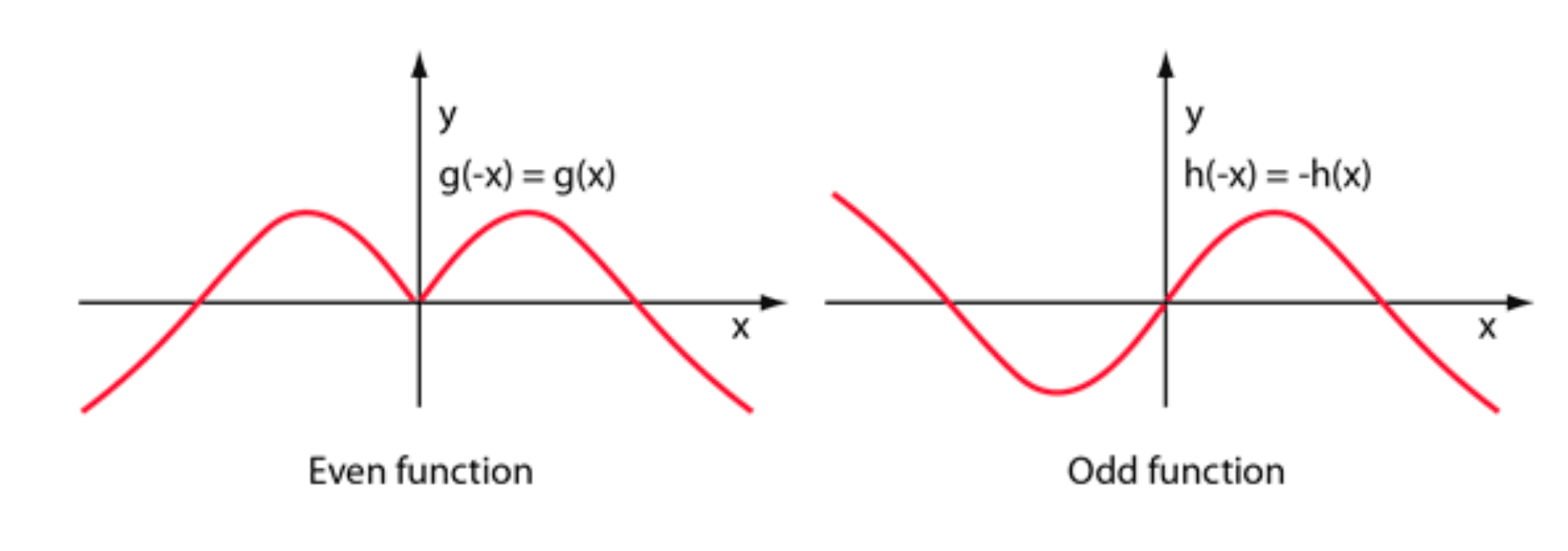
When integrated same amount to both sides from x=0,
Even functions,
∫−aaf(x)dx=2⋅∫0af(x)dx
Odd functions,
∫−aaf(x)dx=0
- Odd functions cancel out, Evens add up.
If a function does not hold the definitive properties of Odd or Even, those functions are Neither Even Nor Odd
- Product
even×evenodd×oddodd×even=even=even=odd
- Any real valued function can be expressed as a sum of an odd func and even func
f(x)=odd(x)±even(x)
Suppose f(x) is a real valued function.
Then,
f(x)=E(x)+O(x)—(1)
E(x) - Even function, O(x) - Odd function
f(−x)=E(−x)+O(−x)
f(−x)=E(x)−O(x)—(2)
E(x)=2f(x)+f(−x)
O(x)=2f(x)−f(−x)
These two function components are unique for f(x) i.e. Only one pair exists