Semester 3MathematicsDifferential EquationsLaplace Transform
Laplace Transform Table
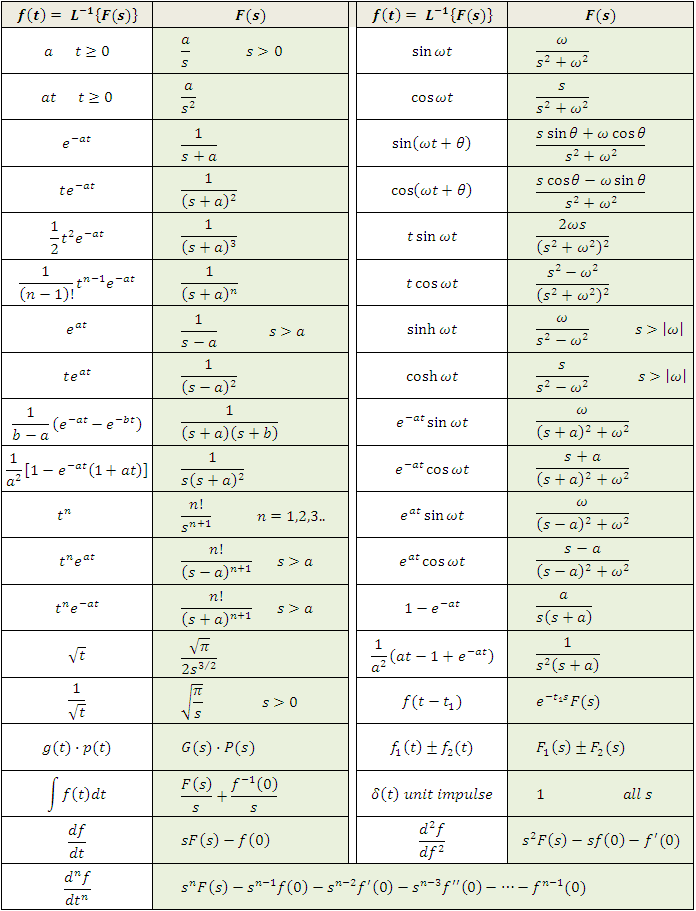
1. Unit Step Function
The Unit Step Function models a sudden "turn ON" switch at time .
(At , is often defined as or left undefined).
Key Properties:
- Time Shift : Turns ON at time instead of .
- Windowing: Multiplying a function by zeroes out the signal before .
- Laplace Transform:
2. Dirac Delta Function
The Dirac Delta Function is a generalized function (or distribution) representing an infinitely tall, infinitely narrow impulse at with total area equal to 1.
\infty, & t = 0 \end{cases} \quad \text{such that} \quad \int_{-\infty}^{\infty} \delta(t) \, dt = 1$$ ![[dirac_delta_func.png|579]] ### Key Properties: - **Sifting Property (Sampling):** Integrating $\delta(t - a)$ against a continuous signal $f(t)$ extracts the single value $f(a)$:\int_{-\infty}^{\infty} f(t) \delta(t - a) , dt = f(a)
- **Scaling Property:** $\delta(at) = \frac{1}{\vert{}a\vert{}} \delta(t)$ - **Laplace Transform:**\mathcal{L}{\delta(t)} = 1
\mathcal{L}{\delta(t - a)} = e^{-as}
## The Fundamental Relationship Between $\delta(t)$ and $u(t)$ The Dirac Delta Function is the **generalized derivative** of the Unit Step Function:\frac{d}{dt} u(t) = \delta(t)
u(t) = \int_{-\infty}^{t} \delta(\tau) , d\tau
### Physical Intuition: - **Unit Step $u(t)$:** Represents a continuous force or voltage that suddenly steps up (e.g., throwing a switch to 1V). - **Dirac Delta $\delta(t)$:** Represents an instantaneous force spike or impulse (e.g., striking a baseball with a bat or a instantaneous voltage surge).