Different OS Types
OS can be categorized by two criteria
- Based on how they do CPU Scheduling (Processing Architecture)
- Based on how and where they are being used (Device Platform)
By Processing Architecture
Batch Operating System
No direct UI is provided for users, CPU Jobs with similar requirements are gathered and run sequentially. This have high offline throughput but does not provide any user feedback.
Ex: Early IBM mainframe systems, payroll processing pipelines.
Multitasking Operating System
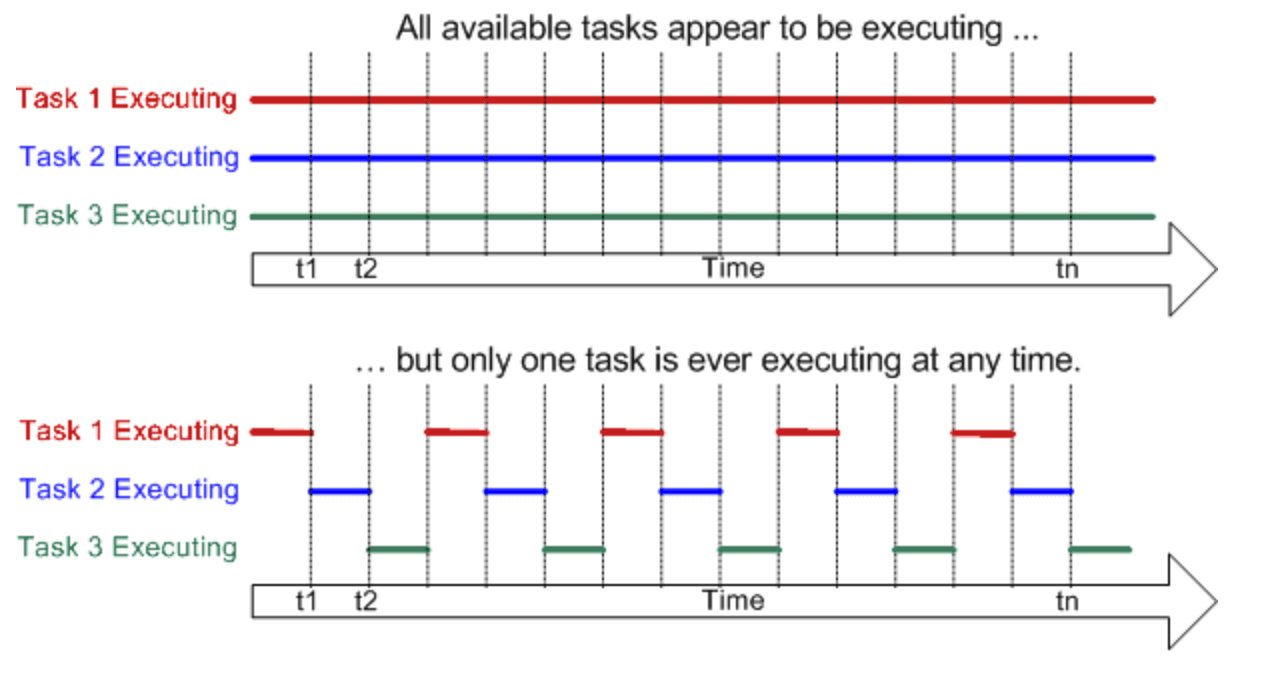
These are the operating systems we use, widely known for operating systems. They schedule the cpu to rapidly switch between different processes to execute multiple tasks concurrently, creating an illusion of its all happening "Parallelly". These provide usable UI for end user. Also provide Interactive Computing capability.
Ex: Windows, MacOS, Ubuntu, Unix
Real-Time Operating System (RTOS)
These are designed so the Computation result is delivered within a Strict time limit, a deadline.
- Hard RTOS: A missed deadline causes total system failure (e.g., airbag deployment, flight control systems).
- Soft RTOS: A missed deadline degrades quality but is not catastrophic (e.g., video streaming). These prioritize deterministic execution times over raw computing speed.
Examples: FreeRTOS, VxWorks, QNX.
Distributed Operating System
Manages a collection of independent, networked computers and presents them to the user as a single unified system. These share computational load, storage, and memory across multiple physical nodes.
Examples:Plan 9, Apache Mesos (cluster manager layer).
Network Operating System (NOS)
Runs on a server and provides the capability to manage data, users, security, applications, and other networking functions across a local area network (LAN). These provide centralized security and file access across distinct client machines.
Examples: Windows Server, Red Hat Enterprise Linux, Novell NetWare
By Use-case or Device platform
- Desktop / Laptop OS
- Mobile OS
- Server OS
- Embedded / IoT OS