Memorylessness of Distributions
Memorylessness is a property some statistical distributions have. If the future probability of an event only depend on its remaining time, not the time already passed, it has the memorylessness property.
Mathematical Definition
A continuous random variable (representing time or lifetime) is memoryless if, for any non-negative real numbers and :
What This Means:
- : Given that the event hasn't happened in the first units of time.
- : The probability that the event takes more than total units of time.
- : Is exactly the same as starting fresh from time and waiting for units of time.
Examples
-
Memoryless Example: Radioactive Decay or Electronic Components Imagine a lightbulb whose failure model is memoryless. The probability that the bulb lasts for 100 hours more, given it has already lasted for 1,000 hours, is identical to the probability that a brand-new bulb lasts for 100 hours. It does not "wear out" or age over time.
-
NOT Memoryless Example: Human Lifespan or Mechanical Wear A 90-year-old human reaching age 100 has a vastly different probability than a newborn baby reaching age 10. Humans age, accumulate damage, and become more likely to die as time passes. Thus, human lifespan is not memoryless.
Common distributions with Memorylessness
Only Two standard distributions have this property.
| Type | Distribution | Common Applications |
|---|---|---|
| Continuous | Exponential Distribution | Modeling waiting times between Poisson events (e.g., call center calls, radioactive decay, component failures). |
| Discrete | Geometric Distribution | Modeling the number of Bernoulli trials needed until the first success (e.g., flipping a coin until getting heads). |
Visualization
When we have new knowledge "given X lasted time units", the PDF is no longer same. Mathematically, the new conditional formula for is:
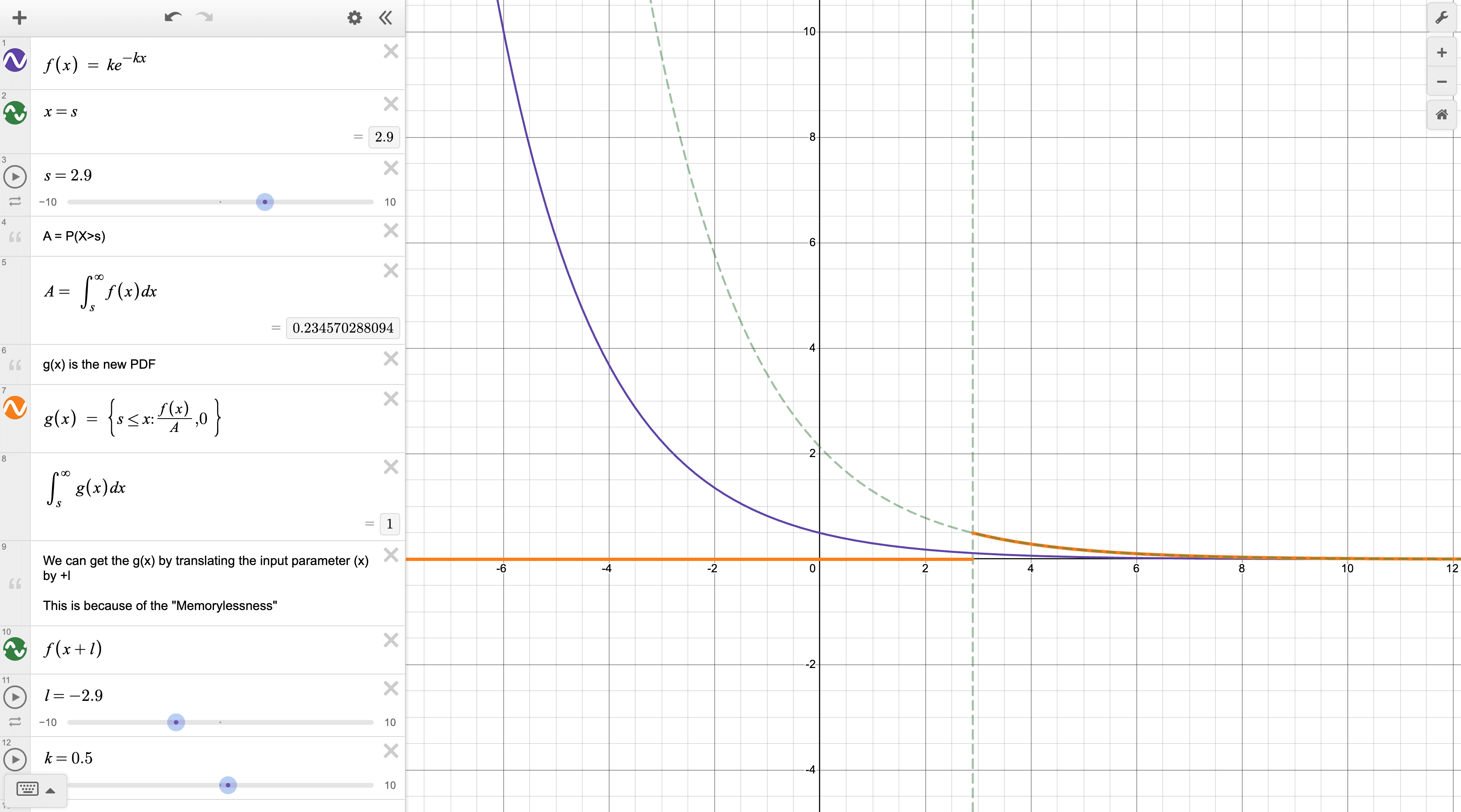 https://www.desmos.com/calculator/xaxksndvgx
the is just shifted to the right. This is only possible on PDFs that have memorylessness property. Note the is completely zero to the left. This is due to that is already observed and has a probability of 0 happening. This is due to we have the knowledge about lasted time units. For example a Uniform Distribution would not give this result. It scales up so cannot ever get