Semester 3MathematicsApplied StatisticsDistributions
Binomial Distribution
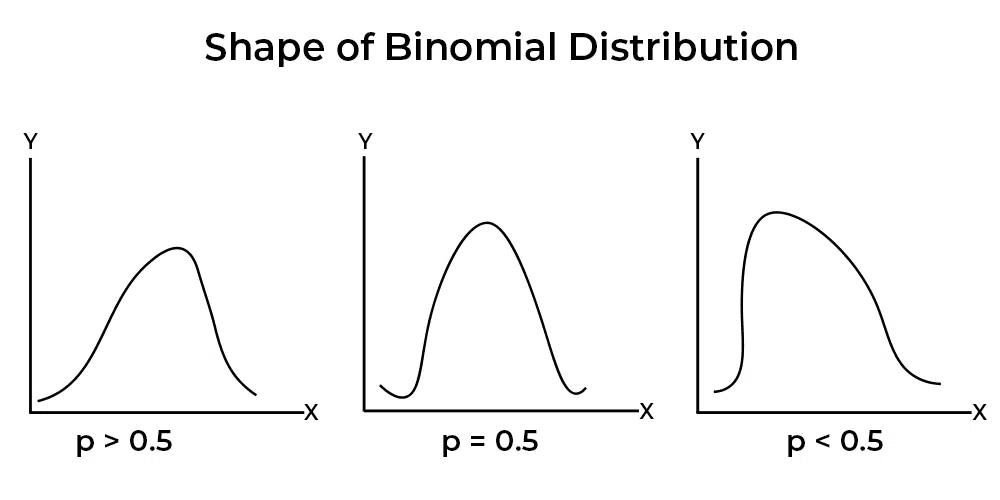
This is a distribution of a series of bernoulli distribution tests. It models the number of successes in a fixed number of independent, identical trials.
1. The Core Idea
To use a Binomial distribution, these Constraints are required. They are intuitive really.
- Binary: Each trial has only two outcomes (Success or Failure).
- Independent: The outcome of one trial doesn't affect the next.
- Number: The total number of trials () is fixed in advance.
- Same probability: The probability of success () stays constant for every trial.
We denote a random variable following a Binomial distribution as:
Where:
- = total number of trials
- = probability of success on a single trial
- = total number of successes (can be any integer from to )
Note: X is the number of successes only. If you wanna model something like probability of "HHT" appear in a 10 times coin flip experiment, binomial is NOT the mode. This is a case of Markov Chains or Pattern Probability
PMF
- Underlined part is the Bernoulli Distribution
Properties
Mean (Expected Value)
Variance