Chi-Square Distribution
This is a distribution made for analyzing how taken samples from a distribution (Normal Distribution) is distributed. So we take values from the distribution and use them to measure how much they vary from the expected.
This is used to see how confident a sample variance to the population variance.
Since values can be or , we use squared sums to avoid cancellations.
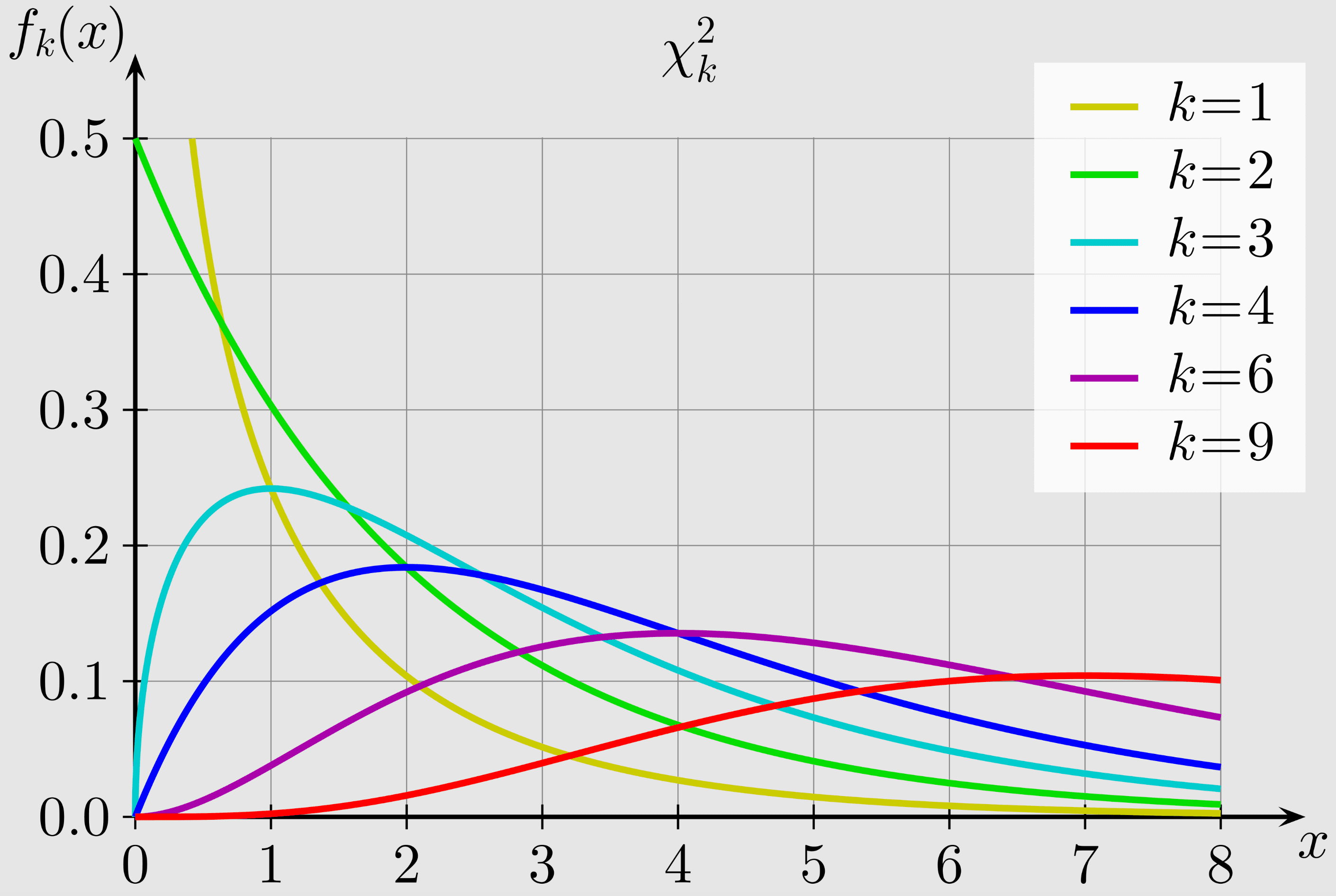
Interactive - https://www.desmos.com/calculator/wygsiv0nlc
Core Idea
if follows a chi-square distribution,
- - Degree of Freedom
Statistic Definition
if are independent standard normal random variables where , the sum of their squares follows a chi-square distribution with degrees of freedom.
For example if we take 10 samples from a normal distribution for one point in the Chi-Square distribution, that has the degree of freedom of . Furthermore, that means each plot point in the Chi-Square is calculated by getting 10 random samples from the normal distribution. (This is the theoretical approach)
- - No. of DOF
Chi-Square Distribution is a special case of Gamma Distribution. This is equal to, Gamma distribution with i.e. , then
Properties
Mean (Expected Value)
- Expected value is equal to the degree of freedom.
Variance
- Variance () is twice the degree of freedom.
Maximum
- Has a maximum value when DOF is 2 or more.
Chi-Square becomes a normal distribution when DOF increases.
Cumulative Probability
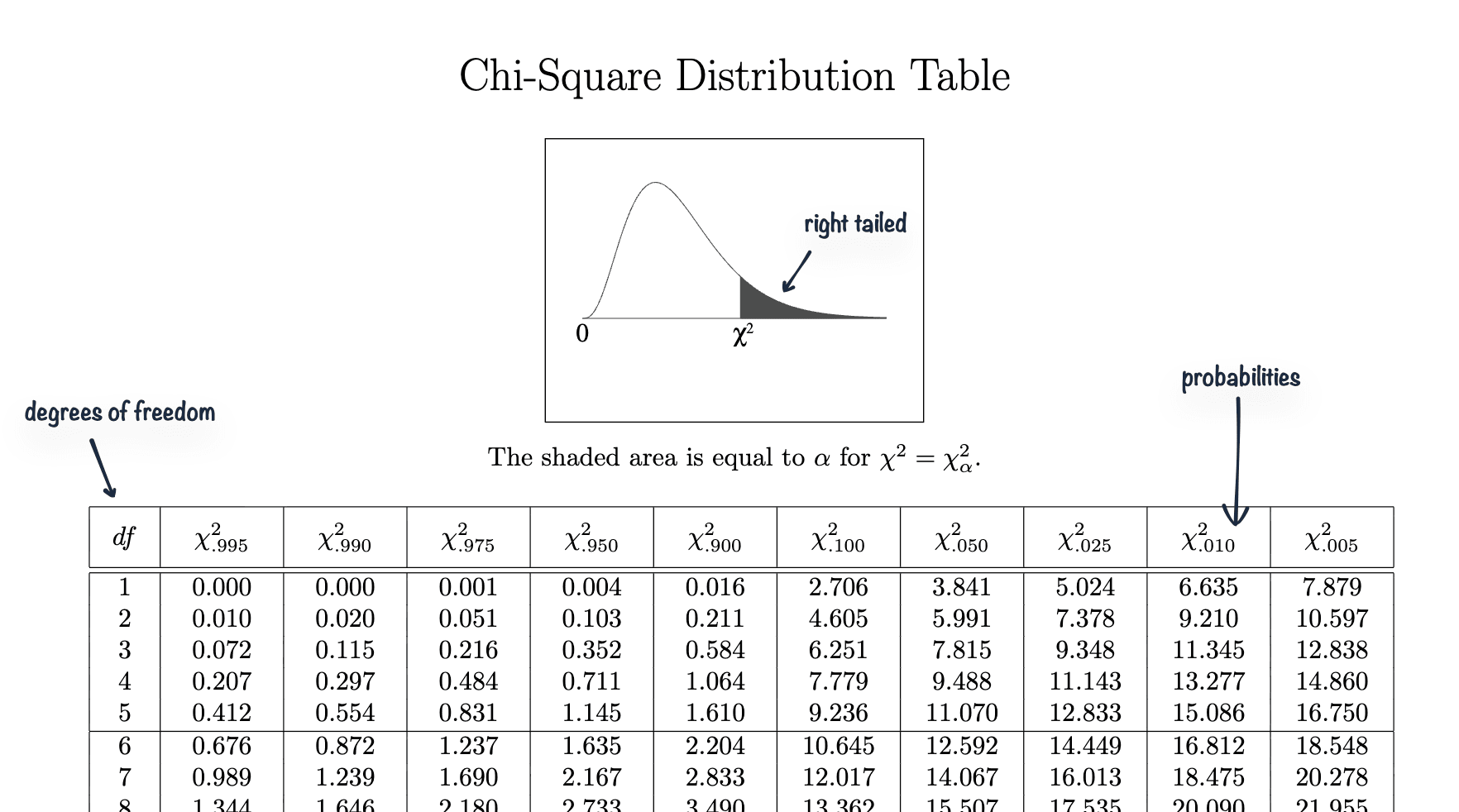
In practical tables, the distribution is given as cumulative distribution. Also the side it measures is important (left-tailed/right-tailed). If right tailed, shaded area is probability of . If left tailed, shaded area is probability of .
Practical use with Sample Variance
- - Sample variance
- - hypothesized population variance
- - sample size
This is useful since in real world we almost never know the true population variance or it is costly to find.
The sample variance is calculated with the correction factor
So to cancel it out and get the theoretical formula for the Chi-Square distribution, we use in the numerator.
Substituting this back into the formula yields: