Negative Binomial Distribution
This is the opposite of Binomial Distribution. Thus called, "Negative binomial distribution". There is no negative probabilities involved, just the idea is the other way around.
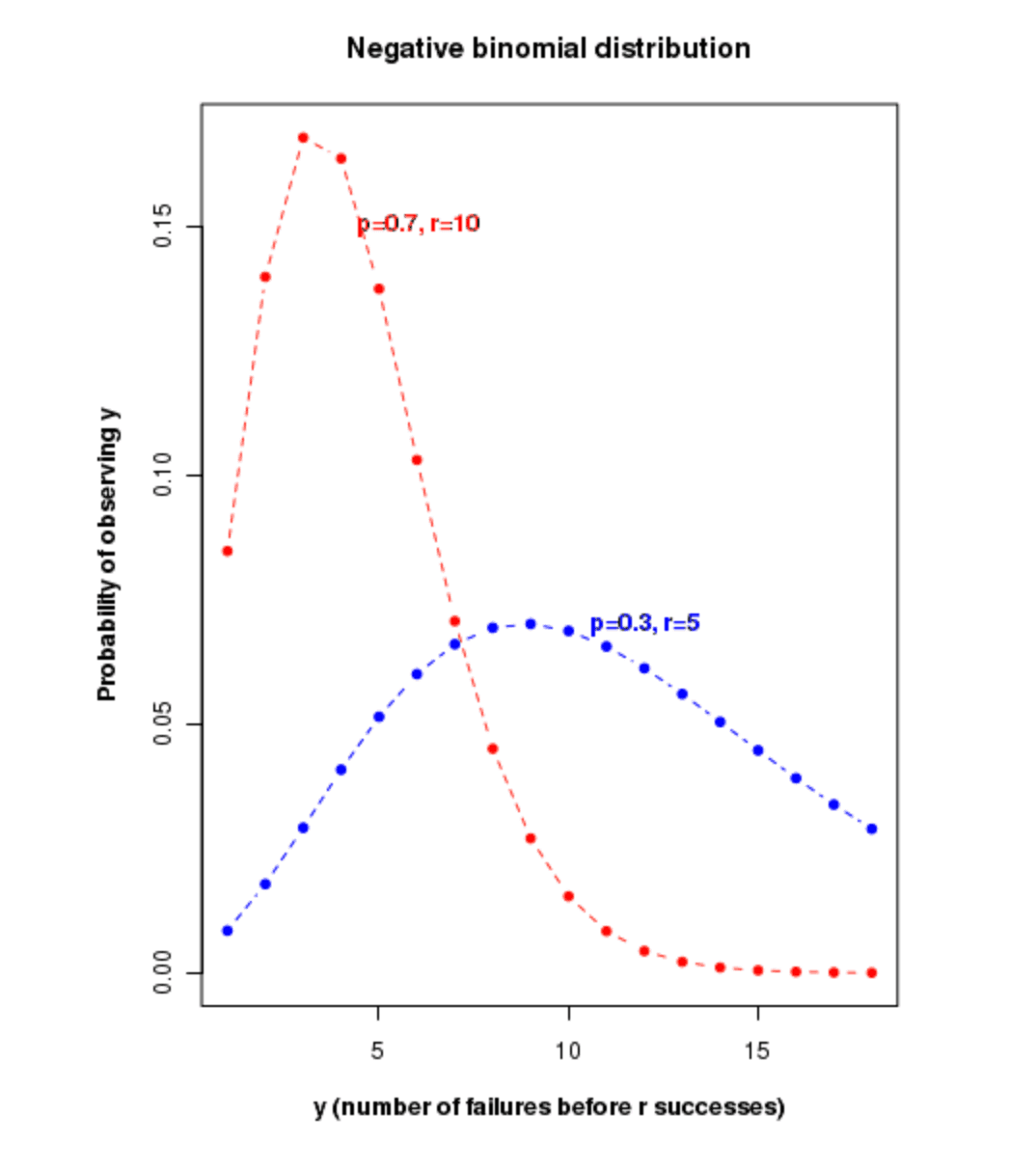
Core Idea
Binomial is about modeling distribution of success cases of a repeating bernoulli experiment. Negative Binomial is about modeling the distribution of failed cases until the first success of a repeating bernoulli experiment.
Imagine you are playing a video game where you need to collect rare items (successes) to unlock a trophy. Each attempt has a success probability . The total number of failed attempts you experience along the way follows a Negative Binomial distribution.
We write this as:
Where:
- = target number of total successes (a fixed positive integer)
- = probability of success on any single trial
- = total number of trials required to achieve successes (here includes failures + successes)
PMF
Explanation: The experiment might go like any of this.
But notice the last item is always . This is because we stop the at the last position. So that is not a probability but a Fact. So we need to find ways to choose spots from positions to distribute them. Thus, term is included. The other part is just Bernoulli Distribution
Properties
Expected Value
Variance